
The Economic Shift: GFRP vs Steel Rebar Cost Comparison
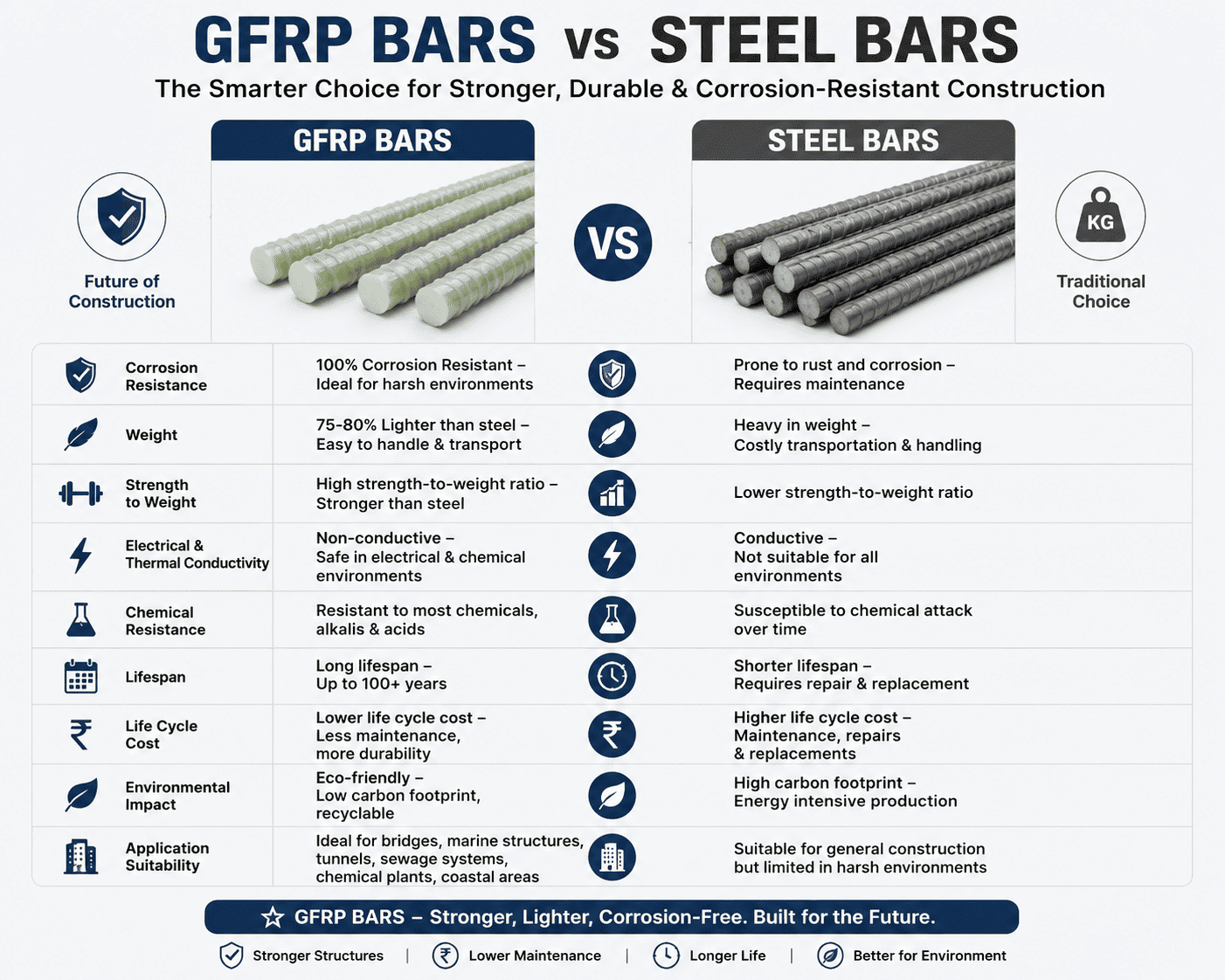
Walking onto a site near the coast, I often see steel rebars showing signs of surface oxidation before the concrete is even poured. It is a constant battle against chloride-induced corrosion. This is why engineers are increasingly looking at Glass Fiber Reinforced Polymer (GFRP) as a viable alternative to traditional steel. When we look at a GFRP vs steel rebar cost comparison, we have to look beyond the initial purchase price. To Know More
While steel might cost ₹60–₹75 per kg, GFRP often carries a higher upfront premium. However, the true economic picture changes when you account for the entire life cycle of the structure, governed by standards like ACI 440.1R or CSA S806. Because GFRP is non-corrosive, you can reduce the concrete cover significantly, saving on materials and reducing the overall dead load of the structure.
Consider these factors in your project estimates:
- Maintenance Savings: No requirement for cathodic protection or expensive epoxy coatings.
- Logistics: GFRP is roughly one-fourth the weight of steel, which drastically lowers transportation costs and site handling labor.
- Durability: In aggressive environments, steel structures may require major repairs within 15–20 years, whereas GFRP designs target a 50+ year service life without structural degradation.
Honestly, the biggest pushback I get from contractors is the inability to field-bend GFRP. You must order specific shapes from the factory, which requires tighter planning. If you try to force a bend on-site, you will compromise the structural integrity. It is an adjustment in workflow, but for infrastructure in harsh climates, the long-term savings on maintenance usually dwarf the initial material cost difference.
Initial Material Costs and Market Volatility
When you look at a quotation, steel rebar usually wins on raw price per kilogram. Currently, TMT steel bars might sit around ₹65 to ₹80 per kg depending on the grade and mill, whereas GFRP rebar is priced per linear meter due to its significantly lower density. This makes a direct GFRP vs steel rebar cost comparison tricky at the procurement stage.
Honestly, steel prices are a rollercoaster. I have seen procurement budgets blow up by 20% in a single quarter because of global iron ore fluctuations or supply chain disruptions. GFRP, being a manufactured composite using pultrusion, offers a far more stable pricing model. While you might pay a premium of 10-15% upfront for GFRP compared to equivalent steel reinforcement, you are essentially buying price insurance against market volatility.
Contractors often complain that GFRP feels expensive because they are used to buying by weight, not by the performance requirements outlined in ACI 440.1R or CSA S806. They forget that because GFRP is roughly one-fourth the weight of steel, you save massive amounts on logistics and site handling. My site teams love that a single worker can carry a bundle of GFRP bars that would otherwise require a crane or three men to move if it were steel. When you factor in the reduced labor intensity for handling and the elimination of rust-proofing measures, the initial cost gap narrows faster than most estimators realize.
The Hidden Expenses of Steel Reinforcement
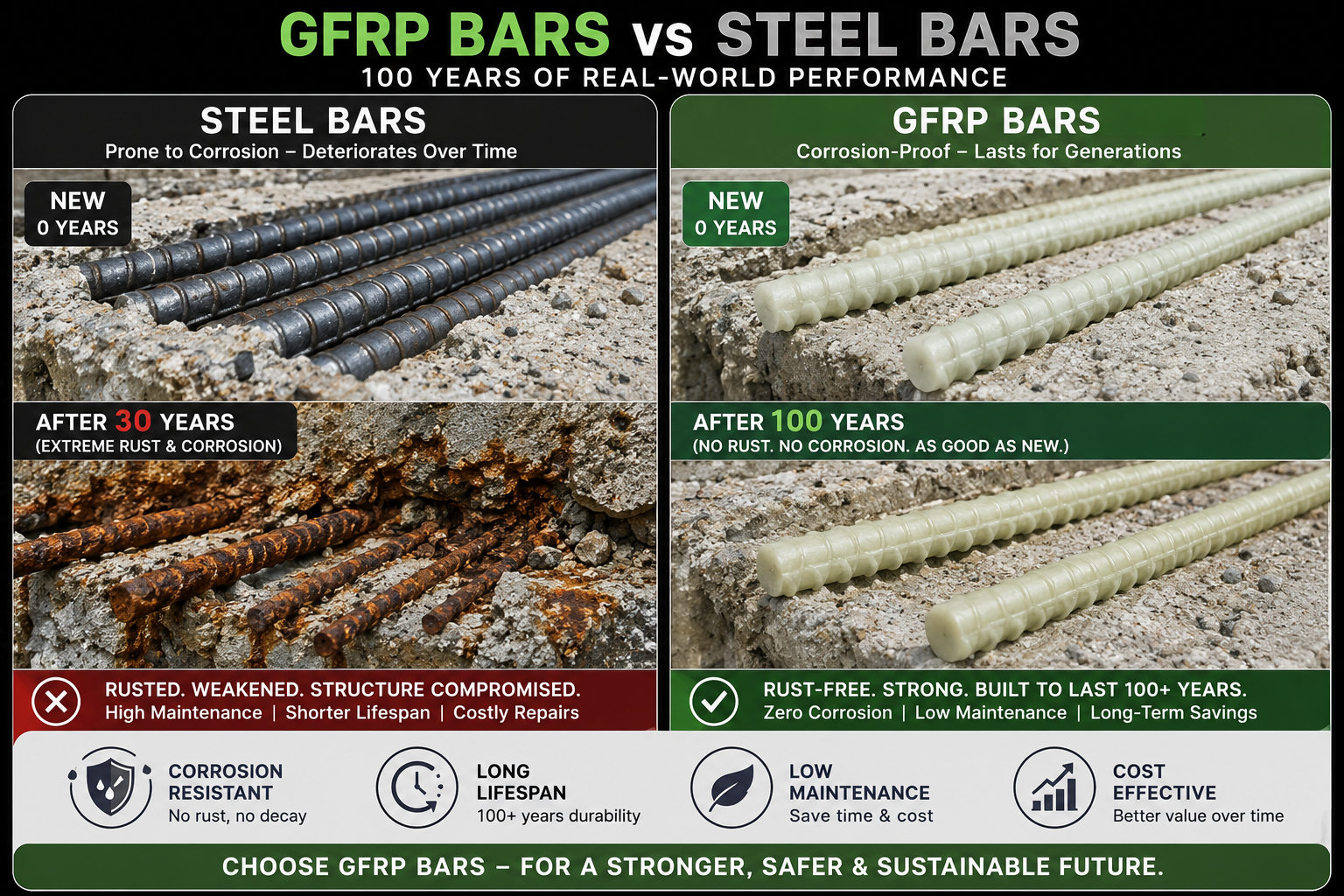
When you look at the initial procurement invoice, steel seems like the obvious winner. But that price tag is a trap. In my field experience across coastal projects, the real cost of steel reinforcement isn’t the material itself—it’s the relentless battle against corrosion. Once chloride ions penetrate the concrete, steel expands, causing spalling that demands expensive, recurring remediation. By the time you factor in specialized anti-corrosive coatings or high-performance concrete additives, the initial savings evaporate quickly.
We also have to talk about concrete cover. ACI 440.1R highlights that because GFRP is immune to electrochemical corrosion, it doesn’t require the same sacrificial concrete cover thickness as carbon steel. With steel, we are often forced to increase cover depths to 50mm or even 75mm in aggressive environments to protect the bars, which significantly hikes up concrete volume and dead load costs. Conversely, GFRP allows for thinner sections.
Contractors constantly complain about the logistics of protecting steel on-site. Honestly, watching a crew try to keep steel bars dry in a humid, monsoon-prone site is exhausting. Between site storage rust, the labor of wire-brushing, and the eventual structural repairs, the GFRP vs steel rebar cost comparison shifts dramatically in favor of GFRP over a 50-year design life. If we followed the durability guidelines in CSA S806 or ACI 440.1R more strictly, many developers would realize that steel’s hidden expenses often exceed the initial investment by 20% to 40% within the first decade alone.
Long-Term Savings: Durability and Maintenance Costs
When you look at a gfrp vs steel rebar cost comparison, the initial invoice is only half the story. In my years overseeing bridge and marine infrastructure projects, I have seen too many structures suffer from premature concrete spalling due to chloride-ion ingress. Steel rusts, it expands, and it destroys the concrete cover. Repairing this, especially with cathodic protection systems, can easily cost ₹2,000 to ₹5,000 per square meter depending on the site accessibility.
GFRP, when designed according to ACI 440.1R or CSA S806, is completely immune to this electrochemical corrosion. You skip the epoxy coatings that often get nicked during transport or site handling, which renders the protection useless anyway. Because GFRP has a much higher tensile strength—often double that of Fe500 steel—we can sometimes optimize the bar diameter, though we must be mindful of its lower modulus of elasticity regarding deflection limits.
Honestly, the biggest headache for contractors on site isn’t the material cost; it is the constant battle with rust staining on finished surfaces and the logistics of handling heavy, fragile epoxy-coated steel. With GFRP, that concern vanishes. While some site crews initially complain about not being able to field-bend GFRP bars like steel, the trade-off is a structure that requires virtually zero maintenance for its design life. If you are building in a high-chloride environment near the coast, the math for long-term savings becomes undeniable, as you effectively eliminate the need for future structural rehabilitation budgets.
Installation Efficiency and Labor Cost Impacts
Handling steel on-site is a logistical headache, especially when you are dealing with heavy crane lifts and back-breaking manual labor. GFRP rebar is roughly one-fourth the weight of conventional steel, which changes the site dynamic entirely. When we run a GFRP vs steel rebar cost comparison, the labor savings often surprise site managers.
Because GFRP is lightweight, a single laborer can carry multiple bundles that would otherwise require three or four men to move. You save significantly on crane time and heavy machinery rental. In my experience, site handling speed increases by 20% to 30% when crews get used to the material. Following standards like ACI 440.1R or CSA S806, the installation process remains straightforward, but you need to respect the material’s properties—don’t try to bend it on-site like you do with mild steel.
Here is where the real cost impact happens:
- Transportation: Lower weight means more rebar per truckload, reducing logistics costs by 15-20% for large projects.
- Labor Efficiency: Faster placement reduces man-hours. At current Indian market rates, skilled labor costs range from ₹600 to ₹900 per day; saving even two days on a large foundation pour adds up quickly.
- Safety: Fewer back injuries and reduced risk of handling heavy metal bars lower insurance and downtime costs.
Honestly, the biggest complaint I hear from contractors is that GFRP is ‘too light’ and moves around during the pour. I always tell them: just use more plastic zip ties or clips. If you try to weld it or use heavy-duty steel tying wire without proper care, you are missing the point of the material. Once they adjust their tying technique, they rarely want to go back to hauling heavy steel.
Making the Financial Case for Your Next Project
Moving beyond initial procurement prices is essential for modern infrastructure. When I review a GFRP vs steel rebar cost comparison, the upfront premium for GFRP—often 15% to 30% higher than TMT steel—is frequently offset by the elimination of expensive epoxy coatings and cathodic protection systems. Honestly, contractors hate the downtime caused by rust-related spalling repairs. By designing to ACI 440.1R or CSA S806 standards, we can often reduce concrete cover requirements, which directly lowers the total volume of concrete needed for a structure.
For projects in aggressive environments, such as coastal bridges or sewage treatment plants, performing a Life-Cycle Cost Analysis (LCCA) is non-negotiable. Here is how I structure the decision framework for my clients:
- Corrosion Exposure: If the structure sits in a chloride-rich zone, GFRP usually pays for itself within the first 10 years by removing maintenance cycles.
- Installation Efficiency: GFRP weighs roughly one-fourth of steel, saving significantly on crane time and labor-related fatigue.
- Long-term Value: Calculate the Net Present Value (NPV) over a 50-year service life; the absence of corrosion-induced rehabilitation costs makes GFRP the clear winner.
On-site, the most common complaint I hear is about GFRP’s inability to be field-bent; you have to order custom shapes. It forces better planning, but it’s a hurdle for teams used to bending steel on the rebar cage. If you ignore the LCCA and focus only on the invoice price, you are missing the bigger picture of project durability.