
Is GFRP Rebar Currently Approved Under Indian Standards?

In my years on-site, I often get asked by project managers if we have a direct equivalent to IS 1786 for composite reinforcements. To be clear: there is currently no dedicated GFRP rebar IS code. The Bureau of Indian Standards (BIS) is actively involved in researching the material, but we are still waiting for a finalized, standalone Indian Standard to govern its structural application.
So, how do we proceed on projects today? Most structural consultants in India currently rely on internationally recognized guidelines to ensure safety and performance. The most widely referenced document is the ACI 440.1R-15, which provides the necessary design equations for fiber-reinforced polymer bars. We also frequently refer to the Canadian standard, CSA S806, for additional guidance on serviceability and durability calculations.
Honestly, waiting for a local code can be frustrating, but it does not mean we are working in the dark. Designing with GFRP requires a shift in mindset compared to traditional steel, specifically regarding its linear elastic behavior and lack of yield point. If you are evaluating this material for a project, I highly recommend reviewing our technical analysis on GFRP rebar disadvantages to understand the specific design nuances—like creep rupture and bond strength—that these international codes address. Until a formal IS code is published, adhering to these established global standards is the most professional path forward.
International Standards: The Current Benchmark for GFRP Design
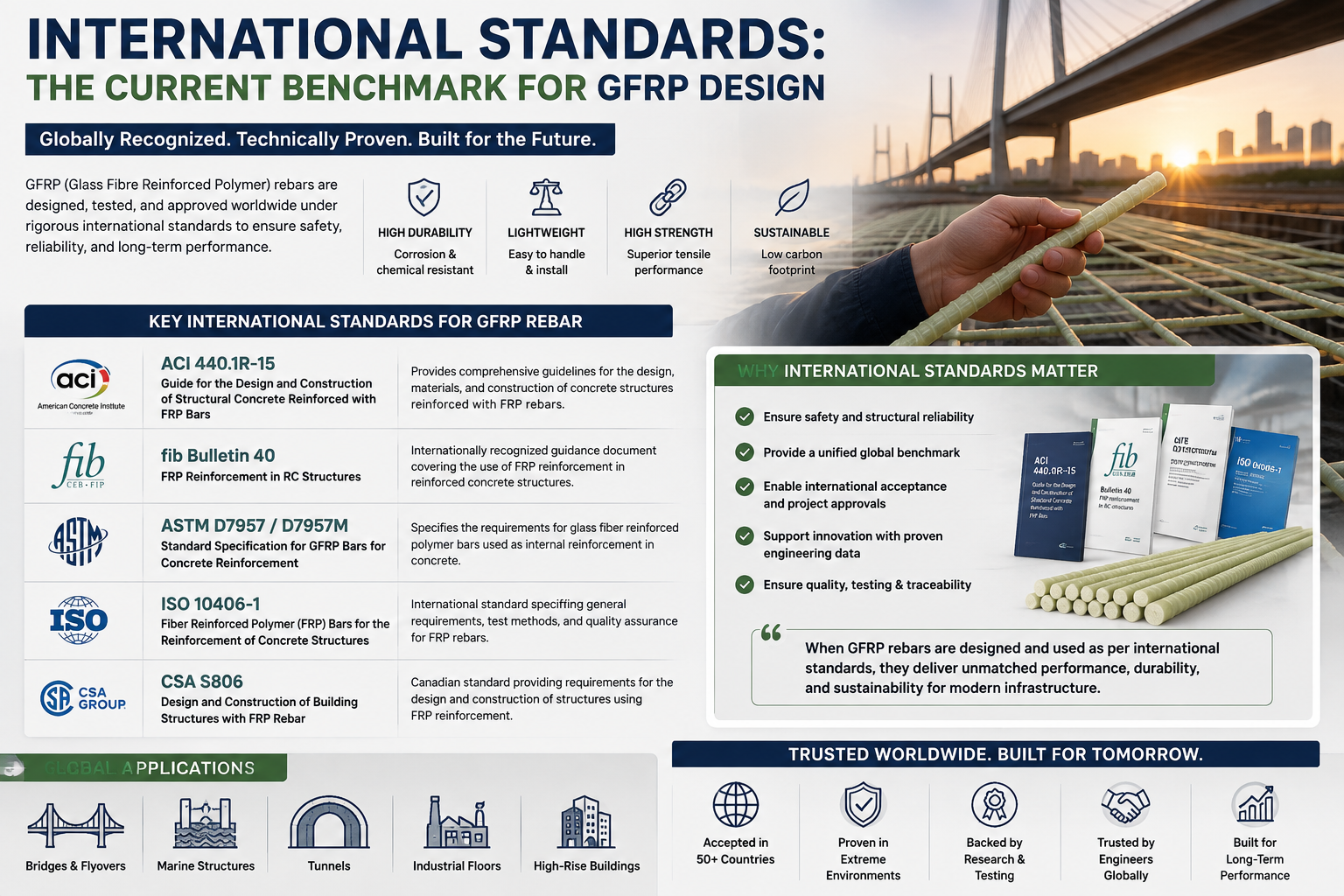
In the absence of a dedicated national standard, Indian structural engineers currently rely heavily on international guidelines to ensure safety and performance. The primary reference point is the American Concrete Institute (ACI) 440.1R guide for the design and construction of structural concrete reinforced with FRP bars. While we eagerly await a comprehensive gfrp rebar is code, ACI 440.1R remains the industry benchmark for calculating critical parameters like tensile strength, bond strength, and environmental durability.
Honestly, relying on international standards requires careful adaptation. Because GFRP behaves linearly elastic until failure—unlike the ductile yielding of steel—we must prioritize serviceability limit states, particularly deflection and crack width control. ACI 440.1R provides the necessary framework to account for the lower modulus of elasticity of GFRP compared to traditional steel. When I am on-site supervising installations, I find that checking these specific design parameters is non-negotiable, especially since we must also be mindful of potential GFRP rebar disadvantages like lower shear capacity.
Beyond ACI, some consultants also reference the Canadian Standard Association (CSA) S806 for its detailed approach to durability. These documents are vital until the Bureau of Indian Standards (BIS) releases a localized code that reflects our specific climate and construction practices. For now, using these international benchmarks is the most responsible way to design durable, corrosion-resistant structures in India.
Essential GFRP Rebar Specifications for Structural Safety
When selecting materials for corrosion-prone environments, engineers must look beyond basic marketing claims. While we await a finalized gfrp rebar IS code, the industry currently relies heavily on international benchmarks like ASTM D7957 and ACI 440.1R to ensure structural integrity. These standards define the critical performance metrics that differentiate high-quality pultruded bars from inferior products.
For any structural application, I insist on reviewing third-party test reports covering the following key properties:
- Ultimate Tensile Strength: Typically ranging between 700 MPa and 1,200 MPa, depending on the bar diameter.
- Tensile Modulus: Unlike steel, GFRP is linear-elastic until failure, usually exhibiting a modulus of 40 GPa to 60 GPa.
- Transverse Shear Strength: Essential for resisting dowel action, this should generally exceed 150 MPa.
Honestly, the most common pitfall I see on-site is the failure to account for the lower modulus of elasticity compared to steel, which directly impacts deflection calculations. Before finalizing your procurement, it is crucial to understand the technical limitations of GFRP rebar to ensure your structural design remains conservative and safe. Always demand a certificate of compliance for every batch delivered to your site; if a supplier cannot provide data backed by an accredited laboratory, walk away. While we anticipate the Bureau of Indian Standards (BIS) will eventually codify these requirements, sticking to these international benchmarks is the only responsible way to proceed today.
Integrating GFRP with Conventional Indian Construction Practices
Transitioning from traditional reinforcement to composite materials requires a fundamental shift in how we approach structural design under IS 456:2000. While our current codes are built around the ductile yielding of steel, gfrp rebar is code compliance—or the lack thereof in native Indian standards—means we often look to international benchmarks like ACI 440.1R for guidance. The most critical adjustment for site engineers is recognizing that GFRP exhibits linear elastic behavior until sudden rupture; it does not yield like steel.
This lack of ductility means that serviceability limit states, particularly crack width control and deflection, often govern the design rather than ultimate strength. Honestly, most site teams find this frustrating at first because it requires thicker concrete sections or tighter rebar spacing to manage deflections. When I oversee site installations, I always emphasize that you cannot simply swap steel for GFRP on a one-to-one basis without re-calculating the strain compatibility.
Practically, you must also be mindful of the material’s specific limitations. Before specifying these bars for your next project, it is worth reviewing the specific technical considerations and disadvantages of GFRP rebar to ensure your design team accounts for lower modulus of elasticity. While the installation process feels familiar to steel fixing, the handling requires care to avoid surface abrasion, which can compromise long-term durability. Moving forward, as we await a formal BIS standard, relying on ACI or CSA S806 methodologies remains the safest path for professional practice.
Understanding GFRP Rebar HSN Code and Trade Compliance
For procurement officers and project managers, classifying materials correctly is the first step in project logistics. In India, the GFRP rebar HSN code is typically categorized under Chapter 70 or 39, specifically 7019 (glass fibers and articles thereof) or 3926 (other articles of plastics). While this classification is essential for GST compliance, customs clearance, and analyzing the 12mm GFRP rebar price in India, it is strictly a fiscal designation.
Honestly, I have seen too many site engineers confuse an HSN code with a quality certificate. Let me be clear: having a valid HSN code for tax purposes does not mean the material meets the structural requirements of Indian standards. It is merely a commercial label.
When you are evaluating material from various gfrp rebar manufacturers india, always demand test reports that align with international benchmarks like ACI 440.1R or ASTM D7957, since a finalized, comprehensive gfrp rebar is code from the Bureau of Indian Standards is still evolving. Relying on an HSN code for structural verification is a dangerous shortcut. Always prioritize mechanical performance data—such as tensile strength and bond stress—over tax documentation when specifying rebar for your concrete designs.
FAQ: Common Questions About GFRP Rebar in India
What is GFRP rebar?
Glass Fiber Reinforced Polymer (GFRP) rebar is a high-strength, non-metallic reinforcement made from pultruded glass fibers held in a resin matrix. Unlike steel, it is completely immune to chloride-induced corrosion, making it ideal for coastal projects or bridge decks where maintenance is a nightmare.
What are the main advantages and disadvantages?
The primary advantage is its exceptional durability in harsh environments and high tensile strength-to-weight ratio. However, engineers must account for its lower modulus of elasticity compared to steel and its inability to be bent on-site. For a deeper look at the technical trade-offs, you should review our guide on GFRP rebar disadvantages before specifying it in your designs.
Where can one find reliable manufacturers in India?
As the market matures, several reputable GFRP rebar manufacturers in India have emerged, though quality control remains critical. Always request third-party testing reports that align with international benchmarks like ACI 440.1R (https://www.concrete.org) while we wait for the finalization of the dedicated GFRP rebar IS code. Honestly, in my field experience, never rely on a datasheet alone; visit the factory and verify their pultrusion process.
Next Steps for Adopting GFRP in Indian Projects
Transitioning from traditional steel to composite reinforcement requires a structured approach. For engineers aiming to integrate these materials, I suggest starting with small-scale pilot projects. This allows your team to get comfortable with handling and installation techniques, which differ significantly from steel due to the material’s lower modulus of elasticity. Before moving to full-scale implementation, perform rigorous testing on your specific batch to verify structural performance against your design requirements.
While we eagerly await a dedicated gfrp rebar is code, international standards remain our best reference. Engineers should rely on ACI 440.1R for design guidance, as it provides the necessary framework for calculating deflection and crack control. Keep in mind that while the material is corrosion-resistant, understanding the practical limitations of GFRP, such as its inability to be field-bent, is essential for successful site execution.
To move forward effectively, follow these steps:
- Review design criteria under ACI 440.1R or CSA S806 to establish baseline safety factors.
- Consult with experienced Bureau of Indian Standards stakeholders to track updates regarding national code development.
- Conduct site-specific pull-out tests to validate bond strength in your specific concrete mix.
Honestly, the most critical step is documentation. Record every aspect of the installation process—from storage on-site to concrete pouring—as this data will be invaluable when presenting your findings to clients or regulatory bodies. Stay proactive, monitor BIS notifications, and treat every project as a learning opportunity for the future of Indian infrastructure.