
Why GFRP Rebar is Essential for Coastal Construction
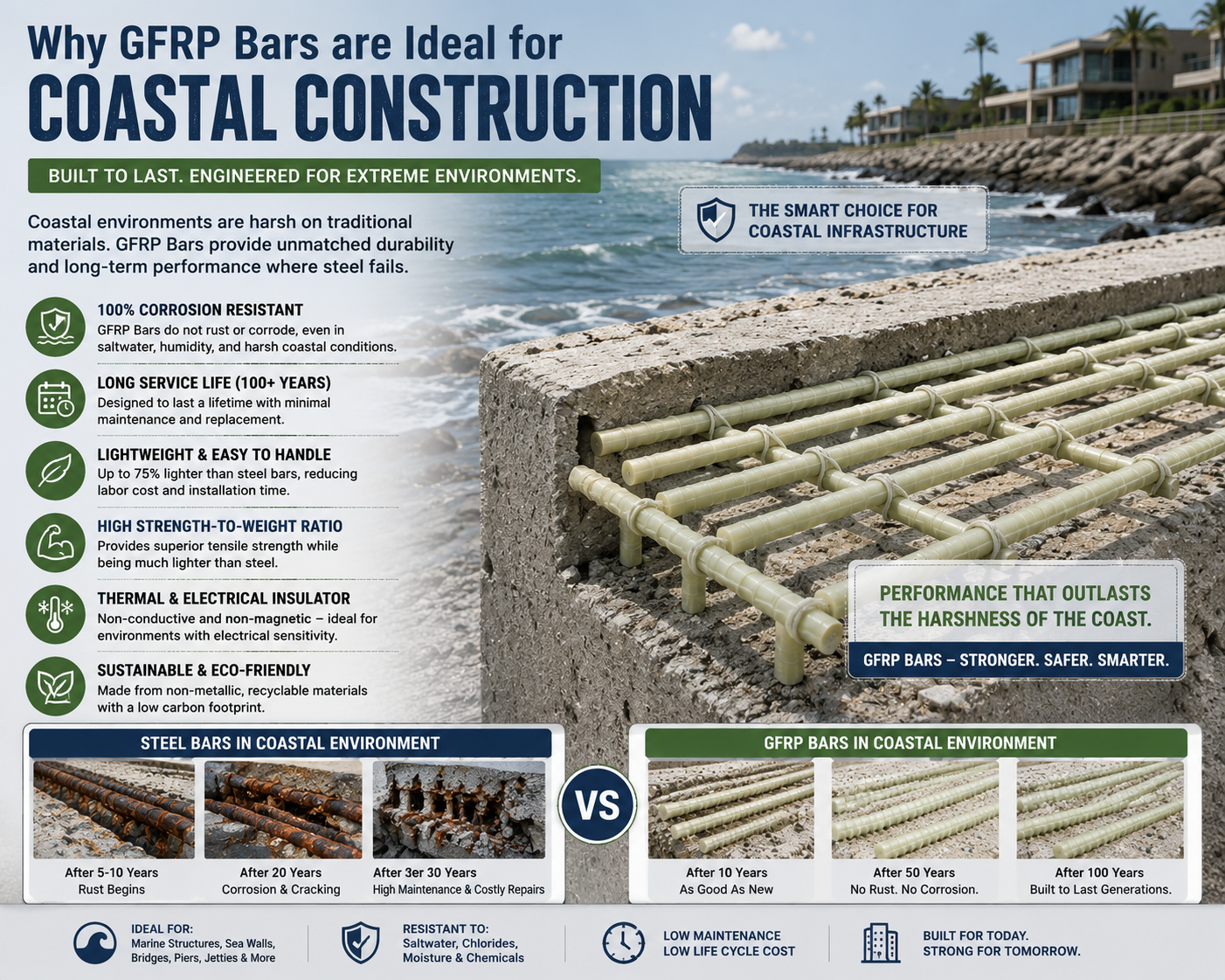
In my years overseeing site work along the Konkan and Coromandel coasts, I have seen too many structures suffer from premature degradation. The primary culprit is always chloride-induced corrosion. When salt-laden moisture penetrates concrete, it attacks traditional steel, leading to internal expansion, cracking, and eventual spalling. This is where GFRP rebar for coastal and marine construction becomes the only logical choice for long-term durability.
Unlike carbon steel, glass fiber reinforced polymer is completely inert to chlorides. By switching to this material, you effectively remove the corrosion mechanism from your design equation. This allows for a design life exceeding 100 years, provided the engineering adheres to ACI 440.1R guidelines for durability. Honestly, the maintenance savings alone are massive; you are eliminating the need for periodic cathodic protection or expensive patch repairs that keep contractors busy but frustrate building owners.
While some engineers worry about the initial investment, a proper life-cycle cost analysis consistently shows that the total cost of ownership is significantly lower than steel in aggressive marine environments. From a site perspective, handling is a breeze because GFRP is roughly one-fourth the weight of steel, which saves on labor fatigue during installation. If you are designing for the next century, stop relying on epoxy-coated steel and start specifying materials that do not rust.
Corrosion Resistance in Harsh Saltwater Environments
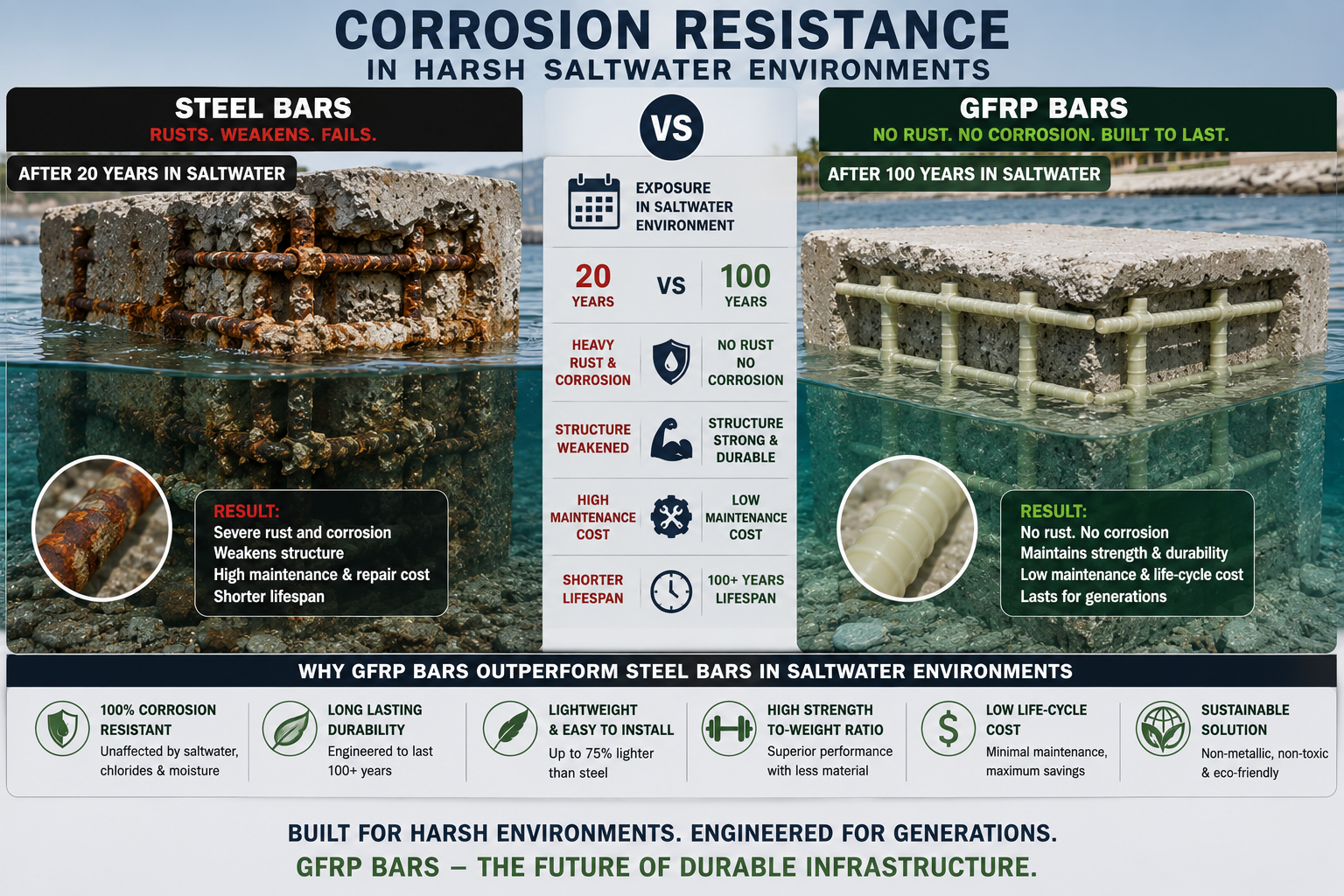
Working on infrastructure projects along the Konkan coast or near the Bay of Bengal, I have seen firsthand how aggressive chloride ions can compromise traditional carbon steel reinforcement. Within just a few years, moisture ingress leads to oxidation, expansion, and eventually, spalling of the concrete cover. This is where GFRP rebar for coastal and marine construction offers a distinct advantage. Because it is chemically inert, it does not rust, regardless of the chloride concentration in the surrounding concrete.
When we look at the material properties, GFRP reinforcement maintains its structural integrity even under prolonged exposure to saline environments. It meets ASTM D7957 standards, ensuring consistent performance in aggressive conditions. Unlike steel, which requires significant concrete cover to prevent corrosion, GFRP allows for thinner cover designs, potentially reducing overall concrete volume. Honestly, the maintenance headaches we avoid by not dealing with rust-stained seawalls or jetty piles are worth the initial investment.
While some engineers worry about long-term material behavior, it is worth noting that when evaluating GFRP vs steel rebar, the life-cycle cost savings often outweigh the upfront material price. In my experience, the key to a successful installation is strictly following the handling guidelines to avoid surface damage, as the material’s strength lies in its intact resin matrix. By adhering to design guidelines like ACI 440.1R, we can build structures that stand up to the sea without the constant fear of degradation.
Applications in Seawalls, Jetties, and Marine Piles
In my experience working on port infrastructure along the Konkan coast, the greatest challenge with traditional steel is the relentless chloride ingress that leads to premature spalling. Using GFRP rebar for coastal and marine construction is a pragmatic shift, especially for marine piles and jetties where heavy logistics are a nightmare. Because these bars weigh about one-fourth of steel, we save significantly on crane time and transport costs when accessing remote, marshy sites.
For seawalls, I particularly value the electromagnetic neutrality of GFRP. Unlike steel, it doesn’t interfere with sensitive sonar or marine monitoring sensors embedded in the structure. While some engineers worry about the initial GFRP vs steel rebar cost comparison, the reduction in long-term underwater maintenance is undeniable. A pile repair in a tidal zone is never cheap, so the durability of composite reinforcement pays for itself within a decade.
When designing these elements, we strictly adhere to established performance guidelines. I typically refer to ACI 440.1R for structural design parameters, as it provides a reliable framework for bond strength and development length calculations. Honestly, the most satisfying part of using GFRP in these projects is seeing the lack of rust staining on the concrete surface months after exposure; it is a clear sign that the reinforcement is holding up against the saline environment exactly as intended.
GFRP Rebar Specifications and IS Code Compliance
As we push for more durable infrastructure along our vast coastline, the technical framework for GFRP rebar for coastal and marine construction is maturing. For years, we have relied on international benchmarks like ACI 440.1R and ASTM D7957 to validate our designs. However, the domestic GFRP rebar code landscape is shifting as the Bureau of Indian Standards actively develops indigenous guidelines for composite reinforcement.
From a site perspective, checking the manufacturer’s data sheet against these global standards is non-negotiable. Typically, you should look for a minimum tensile strength ranging between 600 MPa and 1000 MPa, depending on the bar diameter. One critical performance metric is the guaranteed bond strength to concrete, which often outperforms traditional steel due to the enhanced surface deformation profiles used in modern manufacturing.
Honestly, I have seen too many projects stall because the procurement team focused solely on the 12mm GFRP rebar price in India without verifying the transverse shear strength or the glass transition temperature. When evaluating GFRP rebar specifications, always ensure the material exhibits:
- A tensile modulus of elasticity typically exceeding 40-60 GPa.
- High alkaline resistance, which is vital for preventing degradation in saline marine environments.
- Consistent fiber volume fraction, usually maintained above 70% by weight.
While we await the finalization of the dedicated Indian Standard, adhering to the rigorous testing protocols of ACI and ASTM ensures that our marine structures remain resilient against chloride-induced corrosion.
Cost-Benefit Analysis: GFRP vs Steel Rebar in Marine Projects
In my years overseeing coastal projects, the initial procurement conversation often stalls at the higher upfront FRP rebar price in india compared to conventional TMT steel. However, evaluating GFRP rebar for coastal and marine construction solely on purchase price is a flawed engineering practice. When we look at the total life-cycle cost, the disparity vanishes.
Steel in marine environments requires expensive cathodic protection systems, specialized corrosion-inhibiting admixtures, and significantly thicker concrete covers to prevent chloride ingress. These measures increase both material volume and dead load. By contrast, GFRP is inherently corrosion-resistant, allowing for thinner structural sections and reduced concrete cover requirements as outlined in ACI 440.1R standards. Honestly, the real savings come from the total elimination of maintenance cycles over a 50-year design life.
To help with your project budgeting, consider these practical trade-offs:
- Maintenance: Steel requires periodic inspections and structural repairs due to spalling; GFRP is essentially maintenance-free.
- Design Efficiency: Reduced cover requirements allow for sleeker, lighter structural members, which can lower foundation loads.
- Logistics: GFRP’s lightweight nature simplifies site handling and reduces labor costs for installation.
For a detailed breakdown of how these figures stack up against traditional steel, you can review our life-cycle analysis. While you might pay more at the gate, you save significantly on the long-term structural health of the asset.
Marine Construction FAQ
What is the fibreglass rebar price in India?
The cost typically ranges from ₹85 to ₹120 per kg. This variation depends heavily on the diameter, total order volume, and specific resin matrix used. For a detailed breakdown of how these costs compare to traditional reinforcement, you can review our GFRP vs steel rebar cost comparison, which accounts for life-cycle savings in harsh environments.
Who are the top GFRP rebar manufacturers in India?
The market is maturing rapidly, with leading suppliers now operating specialized facilities that cater specifically to large-scale infrastructure and port projects. When vetting vendors, always request test certificates confirming compliance with international benchmarks like ACI 440.1R to ensure the material meets the necessary tensile and bond strength requirements.
Can GFRP rebar for coastal and marine construction be used for all structure types?
Yes, it is an excellent choice for any element exposed to splash zones, tidal cycles, or constant high humidity. Honestly, I have seen too many steel-reinforced piers suffer from spalling within a decade; switching to non-corrosive GFRP in these zones is simply good engineering practice. While it is ideal for sea walls and bridge decks, remember that it cannot be field-bent like steel, so your design must account for pre-fabricated shapes right from the start.
Conclusion: The Future of India’s Coastal Infrastructure
As we look toward the next generation of maritime projects, the shift toward non-corrosive reinforcement is no longer optional; it is a necessity. Adopting GFRP rebar for coastal and marine construction is a strategic move to build resilient, maintenance-free infrastructure that survives the harsh chloride-rich environments typical of our extensive coastline. While initial procurement requires careful planning, the long-term savings in repair and rehabilitation are significant.
Honestly, I have seen too many bridge piers and seawalls in India degraded by spalling steel within a decade of construction. Moving away from carbon steel to materials that do not rust is the only way to avoid these recurring costs. When planning your next project, ensure you consult with certified gfrp rebar manufacturers in India to verify that the material properties align with international durability standards such as ACI 440.1R, which you can reference at https://www.concrete.org.
For successful implementation, keep these practical points in mind:
- Always verify the tensile strength and modulus of elasticity against your specific design loads.
- Ensure the site team is trained in handling FRP, as it cannot be bent on-site like traditional steel.
- Request documented test reports for every batch to ensure consistency in resin-to-fiber ratios.
By integrating these high-performance materials today, we are effectively future-proofing India’s coastal infrastructure against the inevitable challenges of environmental exposure.