
Does Monsoon Rain Damage TMT Rebar Before Concreting?
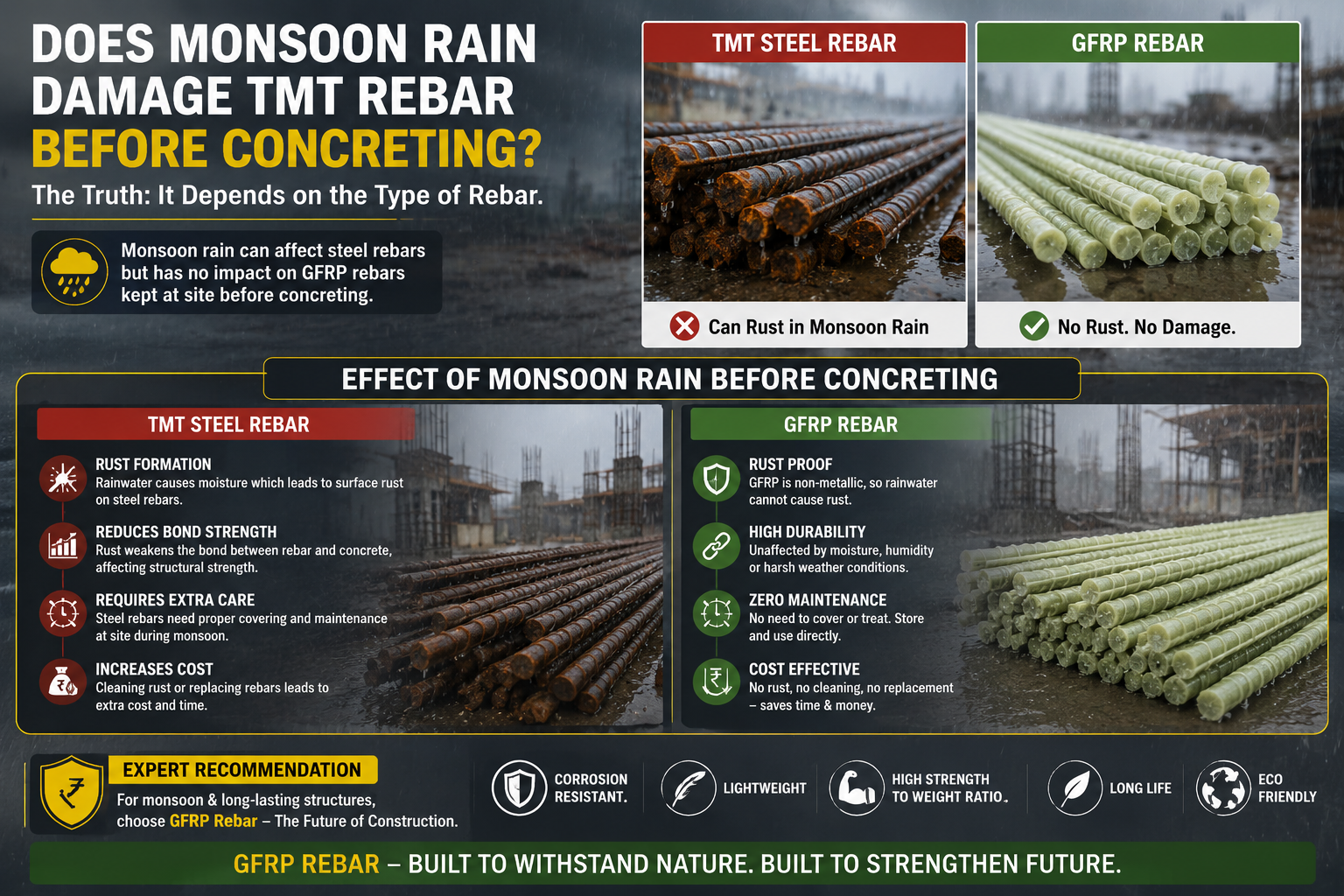
As a site engineer, I’ve seen countless junior supervisors panic when they see rebar turning orange after a heavy downpour. It is a common misconception that TMT bar rusting in monsoon conditions immediately compromises the structural integrity of your project. In reality, light surface oxidation is often superficial. If you can rub the rust off with your thumb or a wire brush and the cross-sectional area remains unchanged, the steel is still perfectly usable.
According to IS 456:2000, reinforcement must be free from loose mill scale and heavy, flaky rust. Interestingly, a thin layer of tightly-adhered rust can actually increase the bond strength between the steel and concrete by creating a rougher surface profile. However, if the corrosion is deep enough to cause pitting or significant loss of diameter, it must be rejected.
Honestly, the real danger isn’t the rain itself, but the long-term chloride ingress once the bar is embedded. If you are working in high-humidity or salt-laden environments, you might want to consider GFRP rebar for coastal construction India, as it is completely immune to the electrochemical corrosion that plagues steel in the monsoon. While steel is cheaper upfront, the maintenance headache of rusting bars often outweighs the initial material savings. Always check for excessive flaking—if it’s flaking, the bar’s structural capacity is already compromised, and it belongs in the scrap pile, not your footing.
IS 456:2000 Standards: When to Reject Rusted Steel
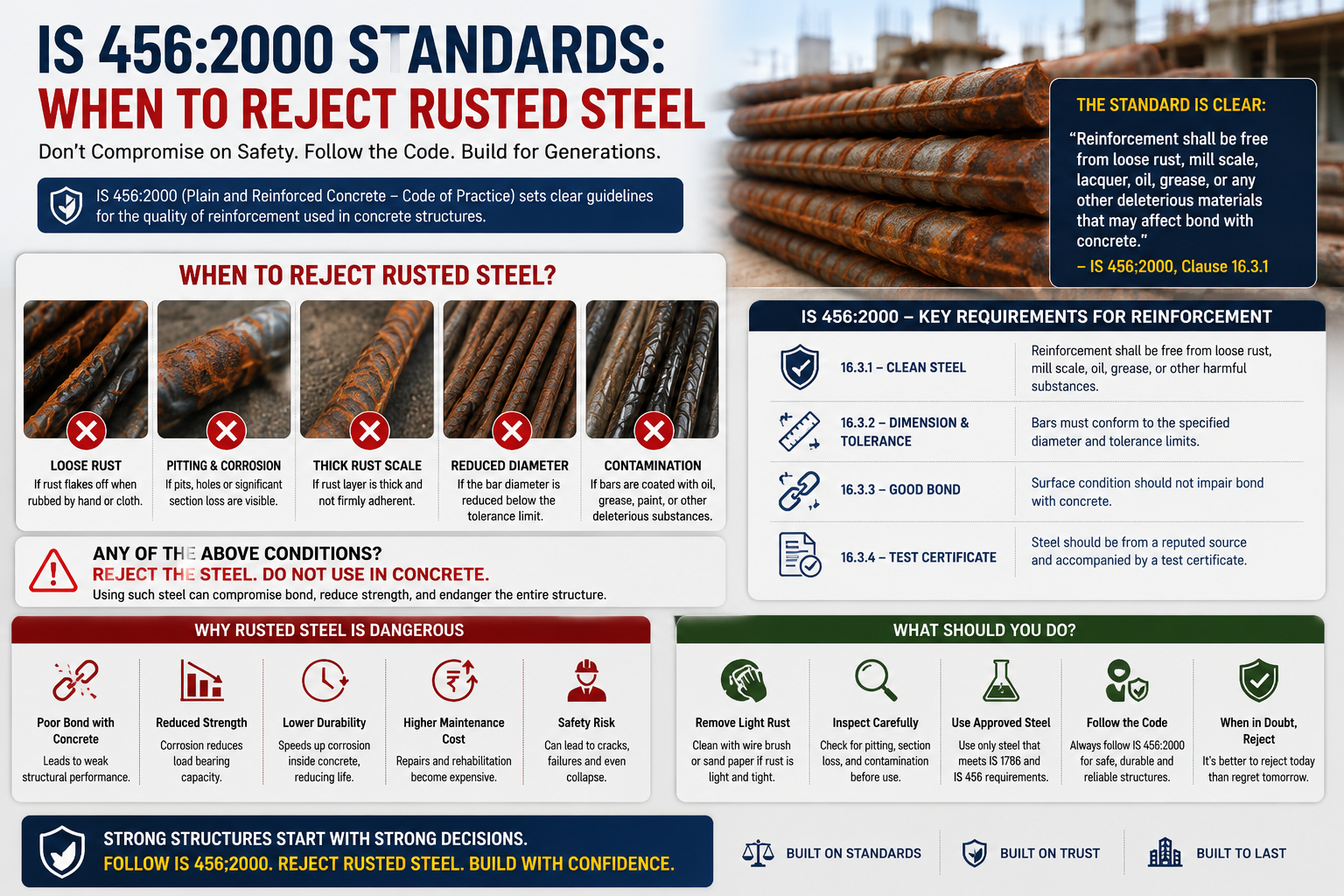
As a site engineer, I have seen many project managers panic at the first sign of surface oxidation. However, IS 456:2000 does not demand a pristine, factory-fresh appearance for steel reinforcement. The standard distinguishes between superficial atmospheric corrosion and structural degradation. If you can wipe the surface with a cloth or a wire brush to reveal the original blue-grey steel, the bar is generally acceptable. In fact, mild surface rust can sometimes improve the mechanical bond between the steel and the concrete.
But, you must know when to draw the line. If the rust is flaky, or if you identify deep pitting that reduces the cross-sectional area and deforms the ribs, the bar must be rejected. Pitting is dangerous because it creates stress concentration points that compromise structural integrity. When questioning can rusted TMT bars be used in construction, always prioritize site-specific testing over assumptions. If the weight loss of the bar exceeds the limits specified by the Bureau of Indian Standards, it is time to discard the batch.
Honestly, the constant battle against TMT bar rusting in monsoon is exactly why many engineers are looking toward alternatives for critical infrastructure. While steel remains the industry standard, in highly corrosive environments, the long-term maintenance costs of steel can be prohibitive. This is why many professionals are considering GFRP rebar for coastal construction in India, as it is completely immune to the chloride-induced corrosion that plagues traditional steel in humid, salty conditions.
How to Store TMT Bars in Monsoon to Prevent Damage
On-site storage is often the weakest link in maintaining material integrity. To properly how to store TMT bars in monsoon, you must break the capillary action that draws moisture from the ground. Always ensure bars are stacked at least 150mm above the soil level using concrete blocks or treated wooden sleepers. Never place them directly on the earth, as the dampness will compromise the reinforcement long before it meets the concrete.
Covering the stacks is mandatory, but simply throwing a plastic sheet over them often does more harm than good. If you trap moisture underneath, you create a greenhouse effect, leading to rapid ‘sweating’ and accelerated oxidation. Instead, ensure the tarpaulin is draped to allow adequate side ventilation. Honestly, I have seen many site supervisors ignore this, only to find the TMT bars covered in thick, flaky rust within weeks.
If your project is located in a high-humidity or saline environment, you might find that even the best storage efforts are an uphill battle against nature. In such cases, switching to GFRP rebar for coastal construction in India becomes a practical engineering decision, as these bars are inherently immune to chloride-induced corrosion. For those sticking with steel, remember that while light surface oxidation is often acceptable per BIS standards, heavy pitting requires immediate mechanical cleaning or rejection. Does rain damage steel rebar before concreting? Absolutely, if it leads to cross-sectional area loss that exceeds the tolerances defined in IS 456.
The Real Long-Term Problem: Chloride Ingress and Carbonation
While site engineers often worry about TMT bar rusting in monsoon, surface oxidation is usually superficial. The real structural threat emerges long after the monsoon ends. Over decades, chlorides from our coastal environment and atmospheric CO2 penetrate the concrete cover, reaching the steel reinforcement. This process leads to carbonation and chloride-induced corrosion, causing the steel to expand up to six times its original volume. The resulting internal pressure cracks the concrete from within, a phenomenon often called ‘concrete cancer’ that compromises the entire load-bearing capacity.
Honestly, no amount of careful storage can prevent this electrochemical decay once the structure is in service. In aggressive marine environments, the passive layer on steel is inevitably breached. This is why many engineers are now considering GFRP rebar for coastal construction in India as a permanent, non-corrosive alternative. Unlike steel, GFRP is inert to chlorides, meaning it does not oxidize regardless of moisture or salt exposure.
For those looking at long-term durability, it is essential to reference standards like ACI 440.1R, which provides guidelines for the design and construction of structural concrete reinforced with FRP bars. While the initial material cost might show a variance in a GFRP vs steel rebar cost comparison, the elimination of recurring repair costs—which can often reach 20-30% of the original construction value in high-salt zones—makes a compelling case for shifting away from traditional steel in critical infrastructure.
GFRP Rebar: Eliminating Corrosion at the Root
In coastal belts or high-moisture zones, battling TMT bar rusting in monsoon is a never-ending site headache. We spend fortunes on epoxy coatings and high-grade concrete cover, yet the chloride ingress eventually wins. This is where Glass Fiber Reinforced Polymer (GFRP) rebar changes the conversation. Because GFRP contains zero iron, it is chemically inert and cannot rust, regardless of humidity or salt exposure.
For engineers, the design shift is straightforward. We now rely on IS 18256:2023, which provides the framework for using FRP reinforcements. While traditional steel remains the standard for dry, inland residential projects, GFRP is a superior choice for marine infrastructure, sewage treatment plants, or bridge decks where long-term maintenance is prohibitive. Honestly, the biggest hurdle isn’t performance—it is the initial procurement.
When you evaluate the GFRP vs steel rebar cost, you must look at the 100-year service life rather than just the per-kilogram price. Yes, the upfront cost for GFRP is higher, but you eliminate the need for cathodic protection and recurring patch repairs. In my experience, if your structure is within 5 kilometers of the coast, the lifecycle savings of a corrosion-free material far outweigh the initial premium of the polymer composites.
FAQ: Common Questions on Rebar Rust and GFRP
Can rusted TMT bars be used in construction?
Yes, provided the rust is limited to light surface oxidation. You should use a wire brush to remove loose flakes and verify that the cross-sectional area of the steel hasn’t decreased beyond the tolerances specified by the Bureau of Indian Standards. If the pitting is deep, the structural integrity is compromised, and the bar must be rejected.
Does rain damage steel rebar before concreting?
Short-term exposure to moisture won’t hurt, but TMT bar rusting in monsoon conditions becomes a real issue if bars are left exposed for weeks. Prolonged saturation leads to heavy scaling, which weakens the bond between the steel and the concrete. Always keep your steel elevated on wooden sleepers and covered with tarpaulins.
What is the frp rebar vs steel rebar cost?
Honestly, GFRP rebar carries a higher upfront material cost, often ranging 20% to 40% more than conventional steel depending on the diameter. However, when you factor in the elimination of anti-corrosion treatments and the extended service life in harsh environments, the life-cycle cost of GFRP is significantly lower. In my experience, for coastal projects where salt ingress is inevitable, the long-term maintenance savings far outweigh the initial premium paid for non-corrosive reinforcement.
Conclusion: Choosing the Right Reinforcement for 2026
Managing TMT bar rusting in monsoon seasons is a constant struggle for site engineers. While strictly adhering to IS 456 guidelines regarding cover depth and storage helps, steel remains inherently susceptible to chloride-induced corrosion in aggressive environments. If you are questioning whether you can use rusted TMT bars, remember that minor surface oxidation is often acceptable, but deep pitting requires structural re-evaluation.
As we move into 2026, the industry is shifting toward more durable alternatives for critical infrastructure. For projects located within 5km of the coastline, it is time to look beyond traditional steel. We now have GFRP rebar for coastal and marine construction in India, which is fully non-corrosive and compliant with the new IS 18256:2023 standards. While the initial GFRP vs steel rebar cost comparison might show a premium for composites, the life-cycle savings in maintenance and repair are significant.
Honestly, the best approach is to match the material to the exposure. Use standard TMT for inland, dry-climate structures, but do not gamble with steel in salt-laden air. Before finalizing your procurement, consult with a structural engineer to review the specific site conditions. If you are planning for long-term structural health, shifting toward IS 18256 certified GFRP is a practical, engineering-led decision that eliminates the monsoon-related headache entirely.