
Is GFRP Rebar Approved in India? The Direct Answer
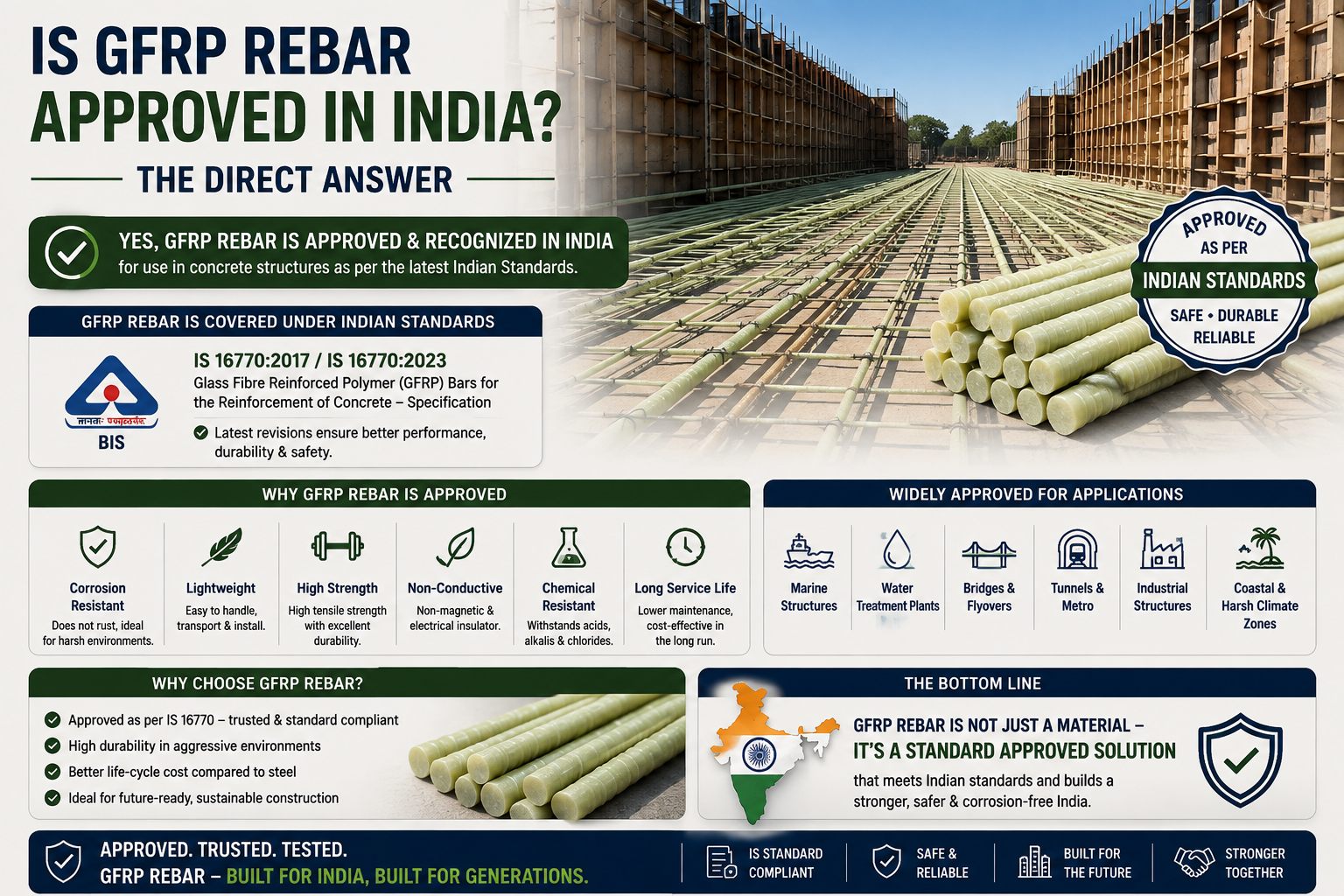
Yes, the ambiguity surrounding non-metallic reinforcement is officially over. GFRP rebar is now standardized in India under IS 18256:2023, published by the Bureau of Indian Standards. This milestone means that engineers no longer have to treat glass fiber reinforced polymer as an experimental material; it has a formal BIS standard for GFRP rebar that defines its manufacturing and testing requirements.
While IS 456 remains the fundamental code for concrete design in India, the industry has shifted toward accepting specialized standards for composite materials. For structural design calculations, engineers can now bridge the gap by referencing this new national standard alongside established international benchmarks like ACI 440.11-22 (from the American Concrete Institute) and the Canadian CSA S806. These international codes provide the necessary design equations for bond strength and deflection that complement our local specifications.
Honestly, having a domestic code makes site approvals significantly easier with municipal authorities and structural auditors. However, design remains different from steel; you cannot simply swap rebar diameters one-to-one. You must perform a full structural re-evaluation to account for the lower modulus of elasticity of GFRP compared to steel. If you are exploring this for your next project, it is worth reviewing our technical guide on coastal and marine applications to understand where this material provides the most significant long-term value.
Understanding IS 18256:2023: The BIS Standard for GFRP Rebar
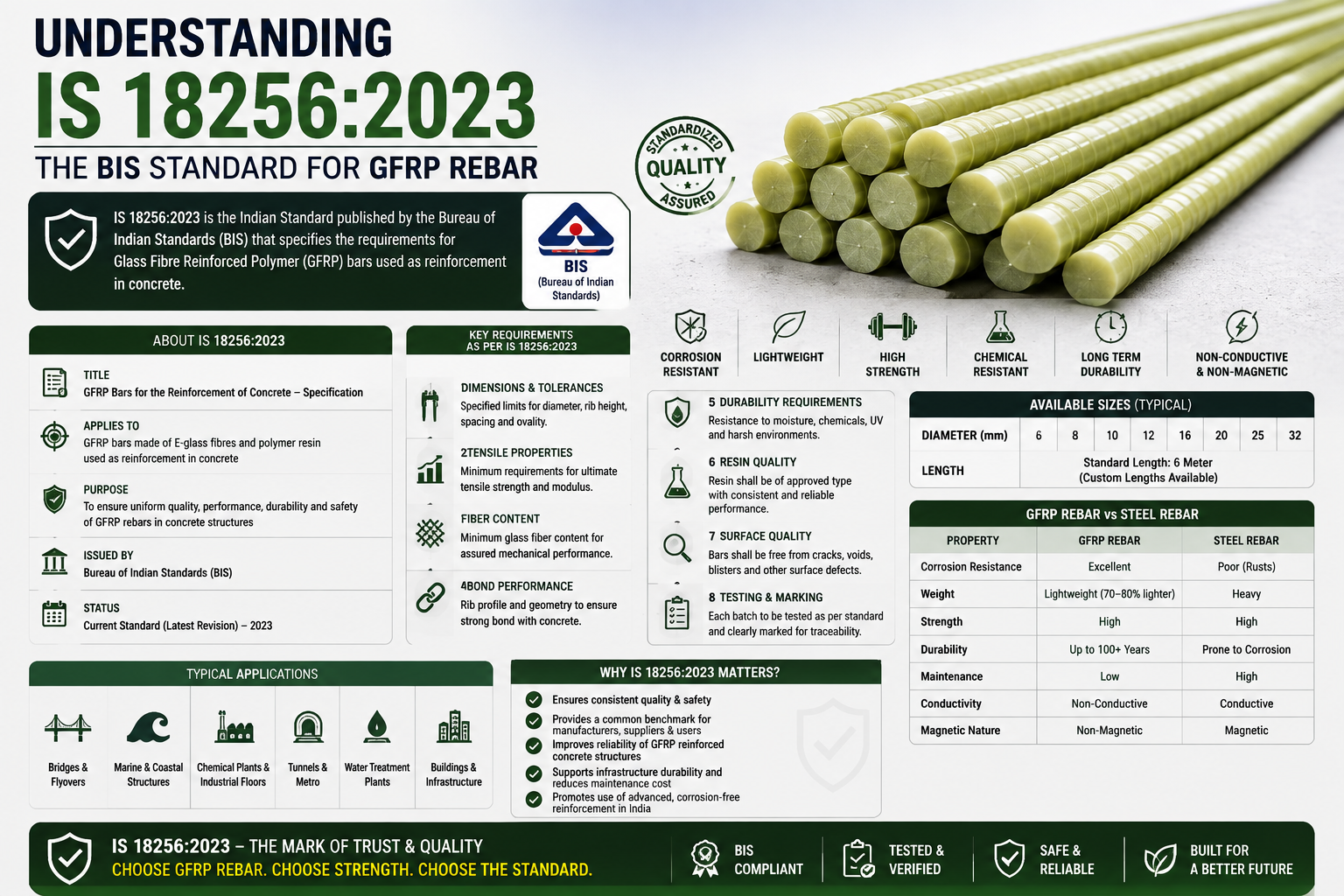
For years, we relied on international benchmarks like ACI 440.11 or CSA S806 to justify using composites. Finally, the introduction of IS 18256:2023 has provided a definitive BIS standard for GFRP rebar, giving us the legal framework we need for mainstream adoption. This code is not just a suggestion; it sets the baseline for quality that every Indian manufacturer must meet.
Key technical requirements under this standard include:
- Fiber Volume Fraction: A mandatory minimum of 70%, which is critical for ensuring long-term durability and structural performance.
- Mechanical Classification: The code categorizes bars into distinct strength and modulus classes, allowing us to specify materials with precision based on load requirements.
- Testing Protocols: Rigorous mandatory testing for tensile strength, bond strength, and moisture absorption.
Honestly, the most significant change this code brings is the enforcement of consistent quality control at the factory level. In my field experience, variations in resin-to-fiber ratios were our biggest headache with earlier, non-certified batches. Now, with a standardized GFRP rebar IS code, we finally have a reliable metric to verify that the material on-site actually matches the design assumptions. If you are looking to understand the long-term economic implications of these high-performance materials, our life-cycle cost analysis is a good place to start comparing the investment against traditional steel.
Design Codes: Moving Beyond IS 456 to ACI 440.11
As a field engineer, I often see colleagues trying to force-fit GFRP into standard IS 456 calculations. Honestly, this is a dangerous shortcut. IS 456 is calibrated for the ductile, yielding behavior of steel. GFRP, however, is linear-elastic until failure. Because it does not yield, you cannot use the same design formulas for bond stress or deflection.
While the new BIS standard for GFRP rebar (IS 18256) provides the necessary material specifications, it does not replace the structural design framework. For actual project execution, most of us currently rely on ACI 440.11-22. This code is the gold standard for calculating development lengths, crack widths, and serviceability limits, specifically accounting for the lower elastic modulus of glass fiber compared to steel.
If you are designing a slab or a bridge deck, you will notice that deflection usually governs the design, not strength. When you switch to GFRP, you have to be much more careful with your span-to-depth ratios to manage serviceability. For those looking at how these design trade-offs impact project budgets, you might want to review our life-cycle analysis to see how upfront design rigor pays off in long-term durability. Moving beyond steel-based intuition is the most important step for any engineer adopting this material.
The Practical Reality of Project Sanctioning and Documentation
As an engineer who has walked many sites, I know that getting a new material approved by PWD or municipal authorities is rarely just about technical merit. It is about paperwork. Since the introduction of the GFRP rebar IS code, specifically IS 18256:2023, the landscape has shifted, but you still need to be proactive. When I submit proposals, the very first document I attach is the manufacturer’s Mill Test Certificate (MTC) explicitly demonstrating compliance with these new BIS standards.
For structural design, authorities are often hesitant to move away from traditional steel. To bridge this gap, I always provide a comprehensive design report based on ACI 440.11. This international framework is widely respected and helps reassure skeptical project managers that the performance metrics—specifically tensile strength and bond stress—are calculated correctly. Understanding the technical limitations and disadvantages of FRP is also essential during these meetings to show you are not just pushing a product, but managing risk.
Honestly, the most common hurdle is the ‘non-conventional material’ tag. You must treat the BIS certification not as an optional attachment, but as the core of your submission. When you present a clear, documented compliance trail, the approval process becomes significantly smoother. Local acceptance is maturing, but your diligence in documentation remains the deciding factor in whether a project gets the green light.
Technical Caveats: Modulus, Brittleness, and Field Limitations
As we navigate the transition toward composite reinforcement, we must be candid about the engineering trade-offs. Unlike traditional TMT bars that yield and provide warning before failure, GFRP is a linear-elastic material; it holds its load until it snaps. Because it lacks this ductility, we require higher safety factors in our designs. While we await a comprehensive BIS standard for GFRP rebar, many Indian consultants currently rely on international guidelines like ACI 440.11 to bridge the gap.
The most critical design hurdle is the low elastic modulus, which is significantly lower than steel. Consequently, serviceability—specifically deflection and crack width control—almost always governs the design rather than ultimate strength. You cannot simply swap steel for GFRP on a one-to-one basis; you will likely end up with excessive deflections if you do.
From a practical site perspective, you must accept that GFRP is a “what you see is what you get” product. You cannot bend these bars on-site once they are cured. If your design requires hooked ends or complex shapes, they must be factory-manufactured to those specifications. For a deeper look at how these constraints impact project planning, review our guide on GFRP rebar disadvantages. Honestly, if your site team tries to heat and bend these bars with a torch, you are compromising the integrity of the entire structural element.
GFRP Rebar IS Code FAQ
Is GFRP rebar approved in India?
Currently, there is no dedicated GFRP rebar IS code issued by the Bureau of Indian Standards (BIS). While steel rebar follows IS 1786, engineers must rely on international guidelines like ACI 440.11 GFRP or CSA S806 for structural design calculations until a domestic standard is finalized.
Is there a difference between HSN codes and engineering standards?
Yes, this is a common point of confusion on site. An HSN code (typically 7019) is strictly for customs and taxation, not for structural performance or safety. Do not mistake a tax classification for a structural approval or a BIS standard for GFRP rebar.
Can GFRP replace TMT bars on a 1:1 basis?
Honestly, no. Because GFRP has a lower modulus of elasticity compared to steel, you cannot simply swap TMT bars for GFRP without a redesign. If you try a 1:1 replacement, you will likely face excessive deflection issues, which is why understanding the technical disadvantages is crucial before specifying it for any project. You must perform a serviceability limit state check to ensure the concrete member remains functional under load.
Conclusion: The Path Forward for GFRP in India
As we move through 2026, the Indian construction sector is finally moving past the experimental phase with non-metallic reinforcement. For structures exposed to aggressive chlorides—such as coastal bridges and marine infrastructure—GFRP is no longer a niche alternative; it is a pragmatic necessity. With the release of IS 18256:2023, we now have a formal BIS standard for GFRP rebar, providing the regulatory backing that many project managers have been waiting for.
However, simply swapping steel for GFRP on a one-to-one basis is a recipe for failure. Because GFRP is linearly elastic until rupture and does not yield like steel, your structural design must strictly adhere to established methodologies. I strongly recommend that design teams utilize ACI 440 design principles to account for the material’s lower modulus of elasticity and unique bond characteristics. In my experience on-site, the most frequent point of failure isn’t the bar itself, but the lack of proper detailing at the lap splices and bends.
For your next project, ensure you specify IS 18256:2023 compliant bars. Verify the manufacturer’s test certificates for tensile strength and bond stress before site delivery. By combining this new GFRP rebar IS code with rigorous ACI-based design, we can deliver durable, corrosion-resistant infrastructure that significantly reduces long-term maintenance costs across India.