Quick answer: The global GFRP rebar market is worth roughly USD 0.54 billion (2025) and is projected to reach USD 0.95 billion by 2030, a 12.1% CAGR, according to MarketsandMarkets. The same publisher values the India GFRP rebar market at USD 56.52 million in 2025, growing at 14.3% CAGR to USD 110.26 million by 2030 — faster than the global average. Demand is led by highways and bridges, coastal and marine structures, and water infrastructure, backed by India’s record public capex and the BIS standard IS 18256:2023.
If you are an engineer specifying reinforcement, a contractor pricing a tender or a builder deciding whether to stock GFRP rebar, market data tells you something practical: whether the material is going mainstream, where supply is heading, and which project types are adopting it first. This guide pulls together the published numbers for the GFRP rebar market — globally and in India — and explains what is driving them, with every figure tied to a named source.
GFRP Rebar Market Size: Global and India
Several research firms track glass fibre reinforced polymer (GFRP) rebar. Their numbers differ because they use different base years, scopes and methods, so it is better to compare them side by side than to blend them into one figure.
| Source | Scope | Base value | Forecast value | CAGR |
|---|---|---|---|---|
| MarketsandMarkets (Sept 2025) | Global GFRP rebar | USD 0.54 bn (2025) | USD 0.95 bn (2030) | 12.1% (2025–2030) |
| Mordor Intelligence | Global GFRP rebar | USD 0.78 bn (2026) | USD 1.47 bn (2032) | 11.07% (2027–2032) |
| MarketsandMarkets | All FRP rebar (glass, carbon, basalt) | USD 0.69 bn (2025) | USD 1.19 bn (2030) | 11.5% (2025–2030) |
| MarketsandMarkets (India page) | India GFRP rebar | USD 56.52 mn (2025) | USD 110.26 mn (2030) | 14.3% (2025–2030) |
Why the estimates don’t match
MarketsandMarkets’ global report starts from 2025, while Mordor Intelligence’s latest edition uses a 2026 base and forecasts to 2032. The broader FRP rebar estimate also includes carbon and basalt bars, so it is naturally larger than a glass-only figure. What every source agrees on is the direction: double-digit annual growth through the end of the decade, with Asia-Pacific growing fastest.
What the India figure tells you
India is still a small slice of the global market — about a tenth of it by MarketsandMarkets’ numbers — but it is expanding faster than the world average (14.3% vs 12.1%). MarketsandMarkets calls India a key growth market within Asia-Pacific and links the demand to smart cities, renewable energy and water management projects, along with adoption in coastal and industrial construction.
Market Segments: Where the Demand Is
The segment data below comes mainly from Mordor Intelligence’s 2026 estimates, which publish percentage shares; MarketsandMarkets data is noted where it adds something.
| Segment | Largest / fastest-growing | Figure | Source |
|---|---|---|---|
| Application | Highways and bridges (largest) | 32.67% of 2026 revenue | Mordor Intelligence |
| Application | Marine structures and waterfronts (fastest) | 12.14% CAGR to 2032 | Mordor Intelligence |
| Resin type | Vinyl ester (largest) | 55.12% of 2026 revenue | Mordor Intelligence |
| Resin type | Epoxy (fastest-growing) | Fastest-growing resin | MarketsandMarkets |
| Bar diameter | 10–20 mm (largest) | 53.78% of 2026 revenue | Mordor Intelligence |
| Region | North America (largest) | 38.23% of 2026 revenue | Mordor Intelligence |
| Region | Asia-Pacific (fastest) | 11.75% CAGR to 2032 | Mordor Intelligence |
Two points matter for Indian buyers. First, the 10–20 mm range dominates — the same sizes used in slabs, footings, pavements and retaining walls (see our GFRP rebar sizes and weight chart). Second, vinyl ester is the leading resin because of its alkali and corrosion resistance, so ask your supplier which resin system their bars use.
What Is Driving the GFRP Rebar Market in India?
1. Record public infrastructure spending
The Union Budget allocated ₹11.21 lakh crore for capital expenditure in 2025–26 and raised it to ₹12.2 lakh crore for 2026–27. Mordor Intelligence specifically cites India’s 2025–26 road and highway allocation of ₹2.76 lakh crore as a demand driver. More roads, bridges, metros and water projects mean more reinforcement — and a growing share of tenders now consider corrosion-free alternatives to steel.
2. A national standard: IS 18256:2023
The Bureau of Indian Standards published IS 18256:2023 — Solid Round Glass Fibre Reinforced Polymer (GFRP) Bars for Concrete Reinforcement — Specification. A national product standard gives consultants and government departments a clear basis for specifying and testing GFRP bars. For what the code covers and how approvals work, read our GFRP rebar IS code and approval guide.
3. Corrosion along India’s coastline and in water infrastructure
Chloride attack in coastal zones, and chemical exposure in sewage and effluent plants, corrodes steel reinforcement and shortens service life. GFRP does not rust, which is why marine structures are the fastest-growing application globally. See how this applies to Indian projects in GFRP rebar for coastal and marine construction and our marine and coastal solutions page.
4. Lifecycle cost over first cost
Owners are starting to compare total cost — including repairs and lost service life — instead of only the per-kg price of reinforcement. GFRP is roughly a quarter of the weight of steel, which also cuts handling and transport cost. Our GFRP vs steel rebar cost comparison works through the numbers for a typical project.
5. New manufacturing capacity
Supply in India is growing quickly. According to the Research and Markets release of the MarketsandMarkets report, the DS Jindal Group entered a 2024 alliance with plans for 12 production units across India by 2026. Hyderabad-based Olectra Greentech launched a GFRP rebar product in April 2025. Alongside these larger players, a base of specialist manufacturers — including TETS RebarX in Ahmedabad — is supplying contractors and builders directly. More local capacity generally means shorter lead times and better price stability for buyers.
Applications Driving Demand
Roads, bridges and pavements
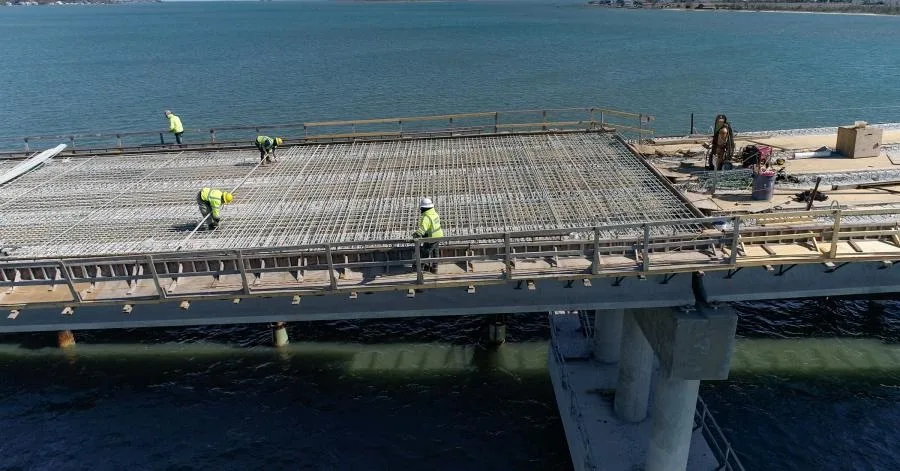
Highways and bridges are the largest application by revenue. Bridge decks, crash barriers, approach slabs and concrete pavements (including dowel and tie bars) are exposed to de-icing salts in some climates and to moisture and chlorides everywhere. Read more on our GFRP for roads page.
Marine and waterfront structures
Jetties, sea walls, ports, coastal roads and seafront buildings are where steel corrodes fastest — and where GFRP adoption is growing quickest.
Water and wastewater
Sewage treatment plants, effluent tanks, sumps and canals benefit from GFRP’s chemical resistance. MarketsandMarkets ranks water treatment plants among the faster-growing applications.
Tunnels, metro and underground works
GFRP is cuttable by tunnel boring machines (the “soft-eye” application) and is non-magnetic and non-conductive, which makes it useful near sensitive equipment. See GFRP rebar for tunnels and underground structures.
Residential and commercial buildings
In homes, GFRP is increasingly used in foundations, plinth beams, slabs on grade, boundary walls and terraces exposed to water. Our guide to GFRP rebar for house foundations and slabs explains where it fits and where steel is still the better choice.
Key Players in the GFRP Rebar Market
Globally, MarketsandMarkets and Mordor Intelligence both list companies such as Dextra Group, Schöck Bauteile, Pultrall, Pultron Composites, SIREG, Neuvokas, Röchling, Armastek and Fibrolux, with Hughes Brothers and Owens Corning also covered by Mordor. Indian names in these reports include Jindal Advanced Materials and ARC Insulations.
The Indian market, though, is far more fragmented than these global lists suggest. A large share of supply comes from regional manufacturers who serve state PWD contractors, real-estate developers and individual house builders. For buyers, the practical test is not brand size but whether the bars are tested to a recognised standard (IS 18256 or ASTM D7957), whether test reports are available for each lot, and whether the supplier can deliver on time. Our guide on where to buy GFRP rebar in India covers what to check.
Challenges Holding the Market Back
- Lower stiffness: GFRP’s modulus of elasticity is much lower than steel’s, so designs are usually governed by deflection and crack width — they need a qualified designer.
- No site bending: bends, stirrups and hooks must be factory-made, so bar schedules have to be fixed early.
- Awareness and tender specs: many department schedules and BOQs still assume steel, which slows approvals.
- Price perception: buyers often compare price per metre without accounting for weight, life and repair savings.
We cover these honestly in GFRP rebar disadvantages. For current rates, see the GFRP rebar price list for India or the 12 mm GFRP rebar price.
GFRP Rebar Market Outlook 2026–2030: What It Means for You
- For engineers and consultants: with IS 18256:2023 in place and adoption rising, expect more clients to ask for GFRP options in corrosion-prone elements. Keep design references and supplier test data ready.
- For contractors: more tenders will allow or require GFRP in pavements, marine works and water structures. Build supplier relationships now, and plan bar schedules early because bends are factory-made.
- For builders and dealers: retail demand is growing for foundations, terraces and boundary walls. Stocking common sizes (8–16 mm) with clear weight and price charts makes the sale easier.
Explore the full range of sizes and specifications on our GFRP rebars product page.
Frequently Asked Questions
What is the size of the GFRP rebar market?
According to MarketsandMarkets, the global GFRP rebar market is estimated at USD 0.54 billion in 2025 and projected to reach USD 0.95 billion by 2030, a CAGR of 12.1%. Mordor Intelligence puts it at USD 0.78 billion in 2026, rising to USD 1.47 billion by 2032.
How big is the GFRP rebar market in India?
MarketsandMarkets values the India GFRP rebar market at USD 56.52 million in 2025 and forecasts USD 110.26 million by 2030, a 14.3% CAGR — faster than the global rate.
Which region leads the GFRP rebar market?
Mordor Intelligence estimates North America held the largest share in 2026 (38.23%), while Asia-Pacific is the fastest-growing region. MarketsandMarkets also expects Asia-Pacific to post the highest growth rate.
Which application uses the most GFRP rebar?
Highways and bridges are the largest application at 32.67% of 2026 revenue, per Mordor Intelligence. Marine structures and waterfronts are growing fastest.
Is there an Indian standard for GFRP rebar?
Yes. IS 18256:2023 is the BIS specification for solid round GFRP bars for concrete reinforcement. Internationally, ASTM D7957 is widely used. TETS RebarX bars are tested to ASTM D7957.
Why is the GFRP rebar market growing in India?
Key drivers are high public capex on roads, metros and water projects, the corrosion problem in coastal and chemical environments, a national product standard, lower handling cost from lighter bars, and new domestic manufacturing capacity.
Will GFRP rebar replace steel completely?
No. GFRP is best suited to elements where corrosion, chemical attack or electromagnetic neutrality matter. Steel remains the standard choice for many structural frames. The market is growing in specific, high-value applications rather than replacing steel everywhere.
Where can I buy GFRP rebar in Gujarat?
TETS RebarX manufactures GFRP rebar in Ahmedabad and supplies contractors, builders and dealers across Gujarat and India. Request a quote below with your sizes and quantities.
Planning a project with GFRP rebar?
Get factory-direct pricing on GFRP rebar tested to ASTM D7957 — from TETS RebarX, Ahmedabad. Share your sizes and quantities and we’ll send a quote.
Or call +91 98257 63402